
The Axon In-Car-Camera (ICC) system is integrated with the ALPR technology. ALPRs automatically capture images of licence plates within the camera’s scanning range. This camera is mounted on the windshield of police vehicles.
In-Car Camera and Automatic Licence Plate Recognition
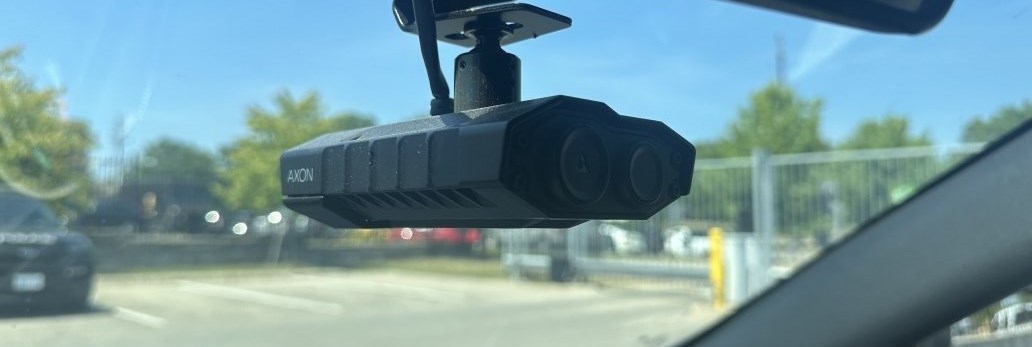
The Niagara Regional Police Service is enhancing public safety and accountability with the installation of In-Car Camera (ICC) systems with integrated Automatic Licence Plate Reader (ALPR) technology.
This investment is supported by a provincial grant aimed at increasing transparency in policing and leveraging technology to improve both community and officer safety.
Automatic Licence Plate Readers (ALPR) – FAQ Questions
What is an ALPR and what does it look like?
How does ALPR technology work?
The mobile system continuously scans licence plates that will alert officers to any “hits” on a “hotlist”. The officer will take appropriate enforcement action to verify the findings.
A hot list is a database that contains millions of licence plates in poor standing. The hot list is populated by the Ontario Ministry of Transportation (MTO) and Canadian Police Information Centre (CPIC). Licence plates that are in poor standing can fall into one or more of the following categories:
- Plates that belong to a driver with a suspended licence.
- Plates associated with stolen vehicles or that are reported stolen or missing.
- Plates that have been suspended.
- Plates with expired validation tags.
- Plates associated with persons with outstanding Canada-wide warrants or who are reported missing.
A hit refers to a scanned licence plate that appears to match a plate on a hot list.
A non-hit happens when a scanned license plate does not match a plate on the hot list.
What information does an ALPR collect?
Where a hit exists, the ALPR alerts the officer with an image of the vehicle (front or rear), with a close-up image of the licence plate. The ALPR hit only notifies the officer of the type of offence. The ALPR camera does not identify any individual or access their personal information through its analysis of licence plate numbers.
What happens if my plate is scanned?
If your licence plate is scanned and is a non-hit, the officer will not be notified that your plate was scanned. All information related to a non-hit is deleted.
The officer must verify all information within the hit before taking any enforcement action. Hit information is retained in accordance with the Municipal Freedom of Information and Protection of Privacy Act (MFIPPA).
Can ALPR devices see into my vehicle or identify individuals?
No, ALPR technology is not designed to collect images of drivers or vehicle occupants.
Does ALPR use facial recognition?
No, ALPR technology does not have facial recognition and cannot detect gender, race, or other identifying characteristics.
Can ALPR systems be used to detect moving violations?
No.
What police vehicles are equipped with this technology?
All unmarked/marked Traffic Enforcement Unit vehicles and all marked uniform police vehicles.
Can I request to view ALPR data related to my vehicle?
All requests to view data must be made through a Freedom of Information (FOI) request.
In-Car Cameras (ICC) - FAQ
What are In-Car Camera (ICC) systems?
The Axon In-Car Cameras (ICC) are integrated with ALPR technology and have audio and video recording capabilities. The police vehicles are equipped with two cameras:
- One forward facing, high-definition, camera attached to the windshield.
- One rear facing, high-definition camera, affixed in the prison compartment.
Why are vehicles being equipped with ICC systems?
ICC systems provide an unbiased, independent account of police interactions. They help the NRPS provide accountability and transparency to the community we serve. Footage collected will be used in police investigations, documented as evidence, and offer an unbiased perspective regarding allegation of misconduct.
How are ICC cameras activated?
Video is generated when the system is triggered through manual activation by the officer or pre-determined automatic triggers such as turning on the roof lights.
How will I know if I’m being recorded?
In-car cameras record what is in the view of the vehicle outside the front windshield, as well as in the back seat of the cruiser. There is a light that is activated and changes from green to red when the camera is recording. Where safe and practicable, police officers will notify individuals that they are being audio/video recorded.
Recording notification stickers will be installed in the prisoner compartment.
Does an ICC camera have facial recognition?
No.
What if I am an innocent bystander and am recorded?
Unrelated information inadvertently captured during an interaction will be redacted.
What happens if someone asks for the camera to be turned off?
Members of the NRPS are not obligated to turn off an ICC camera. If a member of the public does not want to be recorded, they can notify the officer. However, the recording will likely continue if the interaction occurs in a public place.
Can I request to view or delete ICC footage?
All requests for data must be made through a Freedom of Information (FOI) request.
What happens if an officer does not follow ICC procedures?
Complaints about policing services or officer conduct can be submitted through the Law Enforcement Complaints Agency.
Shared Privacy & Data Storage - FAQ
The Information and Privacy Commissioner of Ontario (IPC) has released guidelines on the use of ALPRS by police services. The report ensures that the Police Service’s use of this technology respects citizens' privacy rights recognized under the Canadian Charter of Rights and Freedoms and that personal information is handled in a lawful manner.
Our collection, retention, use, and disclosure of any personal information obtained from the ALPR is done so in compliance with the Municipal Freedom of Information and Protection of Privacy Act (MFIPPA).
How are concerns about privacy addressed?
If you have concerns about privacy and how information in used and/or stored in regards to the ICC/ALPR initiative, you can contact us at ICCALPR@niagarapolice.ca.
Contact Us
Niagara Regional Police Service
Headquarters 5700 Valley Way Niagara Falls,
ON L2E 1X8
T: 905-688-4111
1 District - St. Catharines & Thorold
T: 905-688-4111 Ext: 1024233
2 District - Niagara Falls & Niagara on the Lake
T: 905-688-4111 Ext: 1022200
3 District - Welland & Pelham
T: 905-688-4111 Ext: 1023300
5 District - Fort Erie
T: 905-871-2300
6 District - Port Colborne & Wainfleet
T: 905-735-7811
8 District - Grimsby, Lincoln & West Lincoln
T: 905-945-2211